Pitch
The Complicated History of Pitch
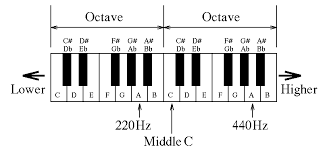
Bell ringers are always concerned about how a set of handbells compares to the Concert Pitch. If you hear us discuss a bell set for sale somewhere, you will hear the inevitable question: ‘Are they in Concert Pitch?’ Unless you have 'prefect pitch' - a rare ability to detect the identify of a given musical note without the benefit of a reference tone - you would probably not be too worries; the bells may sound perfectly in tune with themselves but if you want to play with other handbells sets (in massed ringing at rallies for example) it is important that they are all tuned to the same pitch – so all instrument makers needed to conform to a ‘standard’. Today, Concert Pitch is set at A=440 Hertz (that means that the note A vibrates at 440 times per second).
Prior to the 19th century, there was no real effort to standardise musical pitch and the levels across Europe varied widely. The standard pitch in which Bach, Mozart and Beethoven wrote used the so-called “Classical Pitch” of A=422 Hz. Instruments were being made in England in a whole range of different pitches; Philharmonic Pitch was A=424 in 1813 but had moved up to A=455 by the 1860s. In 1885 Continental Pitch was set at A=435 in but in 1910 J C Deagan persuaded the American Federation of Musicians to adopt A=440 as the standard universal pitch for orchestras and bands.
In 1939 an international conference was set up to look again at a universal pitch. The UK and US agreed on A=440 (although not all were in favour; some wanted the Philharmonic pitch of 1890 about A=453). Following World War I, a little known provision of the Treaty of Versailles (June 28, 1919) adopted A=440 as the standard pitch for all signatory nations.
The British Standards Institute passed a resolution for a pitch of A440 and in December 1939 published a book called "British Standard Concert Pitch".
These days a 'pitch detector' app is available for download to many mobile phones and there are even online versions.
A small chromatic tuner is available here (for example)